Reviews
Part of Silver surface decoration guide: chasing and engraving
Silver decoration methods compared: hammer texture, stamping, chasing and engraving
Silver decoration methods compared by metal movement, tools, support, depth, repeatability, correction limits, surface effects, and suitable design work.
What to take away
- Hammer texture and stamping repeat a face; chasing moves a punch; repousse raises relief from the reverse; engraving cuts metal away.
- The method changes support, layout, tool control, inspection, and correction options.
- Repeatability depends on registered geometry and process records, not on visual resemblance alone.
- A sample must match the alloy, thickness, temper, support, and surface condition of the work.
- Select the method from the desired section and evidence, not from the tool already on the bench.
These methods can coexist on one object, but they are not interchangeable. A shallow crescent made with a stamp may resemble a cut crescent under one light while having a different edge, depth profile, reverse witness, and repair limit.
Comparison at a glance
Metal action
- Hammer texture
- Repeated compression and displacement
- Stamping
- Local impression from a registered face
- Chasing
- Punch moved along the front
- Repousse
- Relief raised mainly from the reverse
- Engraving
- Chip cut from the face
Typical control
- Hammer texture
- Overlap and strike field
- Stamping
- Center, angle, and strike
- Chasing
- Tool path, angle, and light blows
- Repousse
- Broad volume, support, annealing
- Engraving
- Graver geometry and hand path
Main evidence
- Hammer texture
- Repeating face marks
- Stamping
- Motif outline, possible reverse witness
- Chasing
- Displaced line or modeled detail
- Repousse
- Raised form and stretched sheet
- Engraving
- Incised line, chip, and possible burr
Common limit
- Hammer texture
- Uneven field, sheet distortion
- Stamping
- Double strike, drift, excess depth
- Chasing
- Uneven line, support marks
- Repousse
- Tearing, thinning, warped edges
- Engraving
- Slip, cut beyond boundary
A Metropolitan Museum technical study of three silver objects distinguishes chasing, engraving, and repousse evidence on a helmet, including pointed-tool lines, chisel marks, engraved marks, and slightly raised areas. That examination concerns specific ancient objects; it does not authorize a modern tool, heat cycle, or interpretation without close inspection.
Hammer texture
Choose hammer texture for a field whose individual contacts are meant to blend into a planned surface. Face radius, finish, overlap, direction, support, and work rotation shape the result. It is poorly suited to crisp lettering or a motif that must register at an exact coordinate.

Because every blow also forms the sheet, check the reverse and released flatness. A field that looks even while clamped can bow after support is removed.
Stamping
Stamping is efficient for discrete symbols and repeats when the face can be indexed. It owes a scale drawing, center map, orientation mark, matching sample, and clear rule for whether a second strike is permitted.
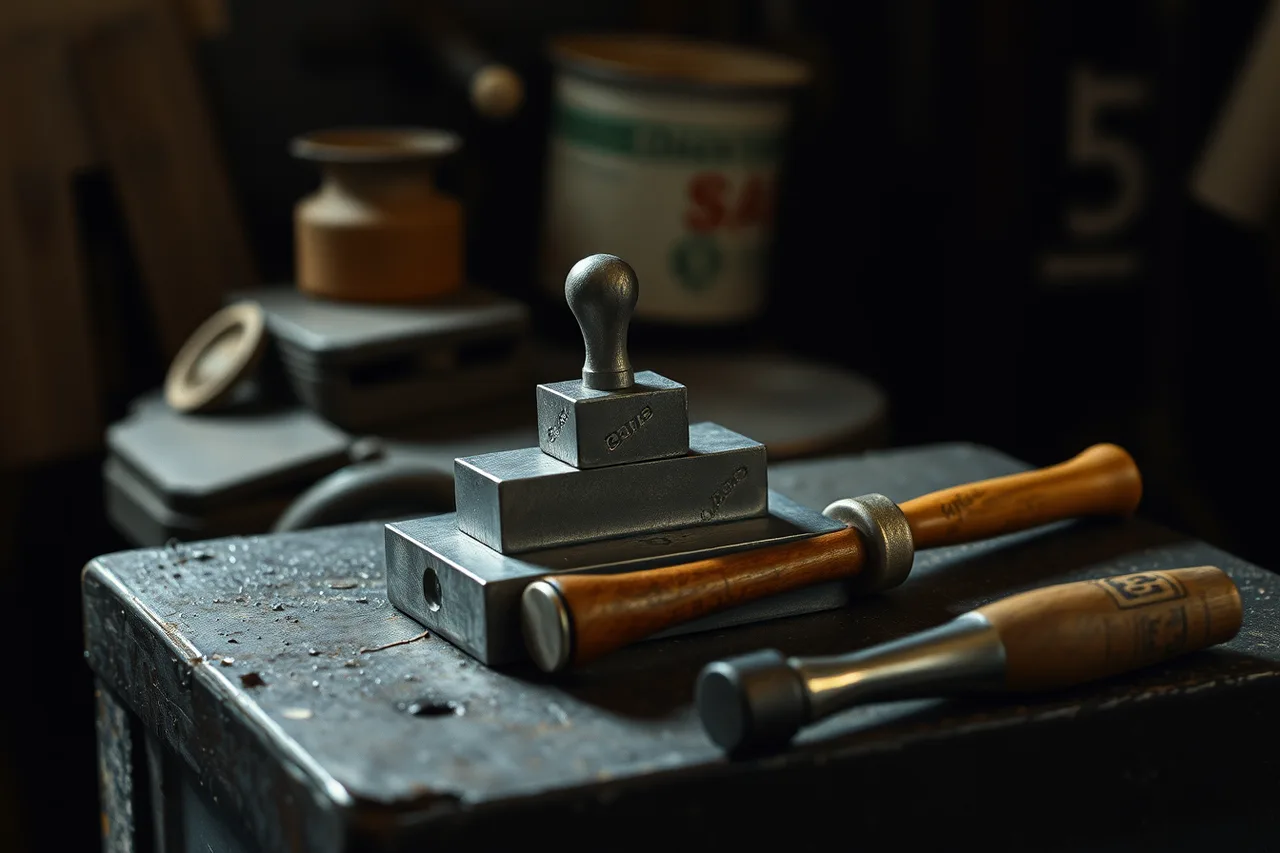
It is less forgiving near a finished edge, thin wall, solder seam, or stone seat. A stamp cannot correct its own positional error by going deeper.
Chasing and repousse
Chasing models detail from the front. Repousse raises broader relief from the reverse, often followed by chasing.
A Wayne State workshop description defines chasing and repousse as work with punches and hammers to transform flat metal into relief. It notes how metal responds to different tools. The article adds its own limits for silver stock, support, annealing, and acceptance.
These methods fit modeled contours and gradual relief better than exact repeated stamps. They usually demand access to both sides, suitable support, and planned work-hardening control.
Engraving
Engraving cuts a line. It suits lettering, outlines, hatching, and details that benefit from a clean incised section. Graver geometry, sharpening, starting cut, line direction, hand support, and chip exit matter.
Unlike a displaced chased line, an engraved cut has removed metal. A slip or deep line cannot be restored by pushing the chip back. Correction may require redesign, refinishing within a minimum-section limit, or rejection.
Selection questions
Ask in order:
- Should the design be flat, indented, modeled, raised, or cut?
- Must the reverse remain unmarked?
- Can both sides be reached and supported?
- Is the pattern unique, continuous, or repeated?
- Which dimensions and construction zones cannot move?
- What defect can be accepted, corrected, or rejected?
- Can the exact process be proven on matching stock?
Use a hybrid sequence only after testing its order. Engraving before heavy forming may stretch lines. Stamping before bending may rotate motifs. Chasing near a completed joint can move it.
Common questions
Is repousse a type of stamping?
No. Repousse builds relief through progressive work from the reverse rather than transferring one fixed stamp face.
Which method is most repeatable?
Registered stamping can repeat a motif efficiently, but actual repeatability still depends on support, force, orientation, stock, and inspection.
Does chasing remove metal?
Chasing primarily displaces metal. Engraving deliberately cuts material away.
Can methods be combined?
Yes, after samples establish the sequence, support, dimension changes, and finish effects.