
Features
Part of Silver surface decoration guide: chasing and engraving
Repair Misaligned Stamped Silver Border: Fictional Scenario
A fictional scenario treats “repair misaligned stamped silver border” as a craft problem, tracing drift, a corner redesign, and release checks.
What to take away
- This fictional case shows a bounded redesign, not a universal repair recipe.
- The team measured the original centers and margins before touching the error.
- Restraining the repair to a planned corner transition avoided deeper restriking across the border.
- Matching coupons tested the revised geometry, reverse witness, flatness, and finish.
- The panel was accepted only after construction zones and minimum thickness still passed.
This fictional scenario treats “repair misaligned stamped silver border” as a craft problem. A workshop had a 70 by 38 mm sterling-silver panel intended for the lid of a small fabricated box. The drawing called for a row of 2 mm leaf stamps, centered 2.8 mm from the edge, with equal corner margins. After 11 impressions, the operator noticed that the row was moving outward.
All dimensions, tolerances, measurements, and decisions below are invented for teaching. They do not describe a museum object or establish a repair standard.
The stop record
The operator stopped before the corner. The panel was removed from its block without flattening. Face and reverse photographs were made under raking light. Each existing motif received a coordinate number.
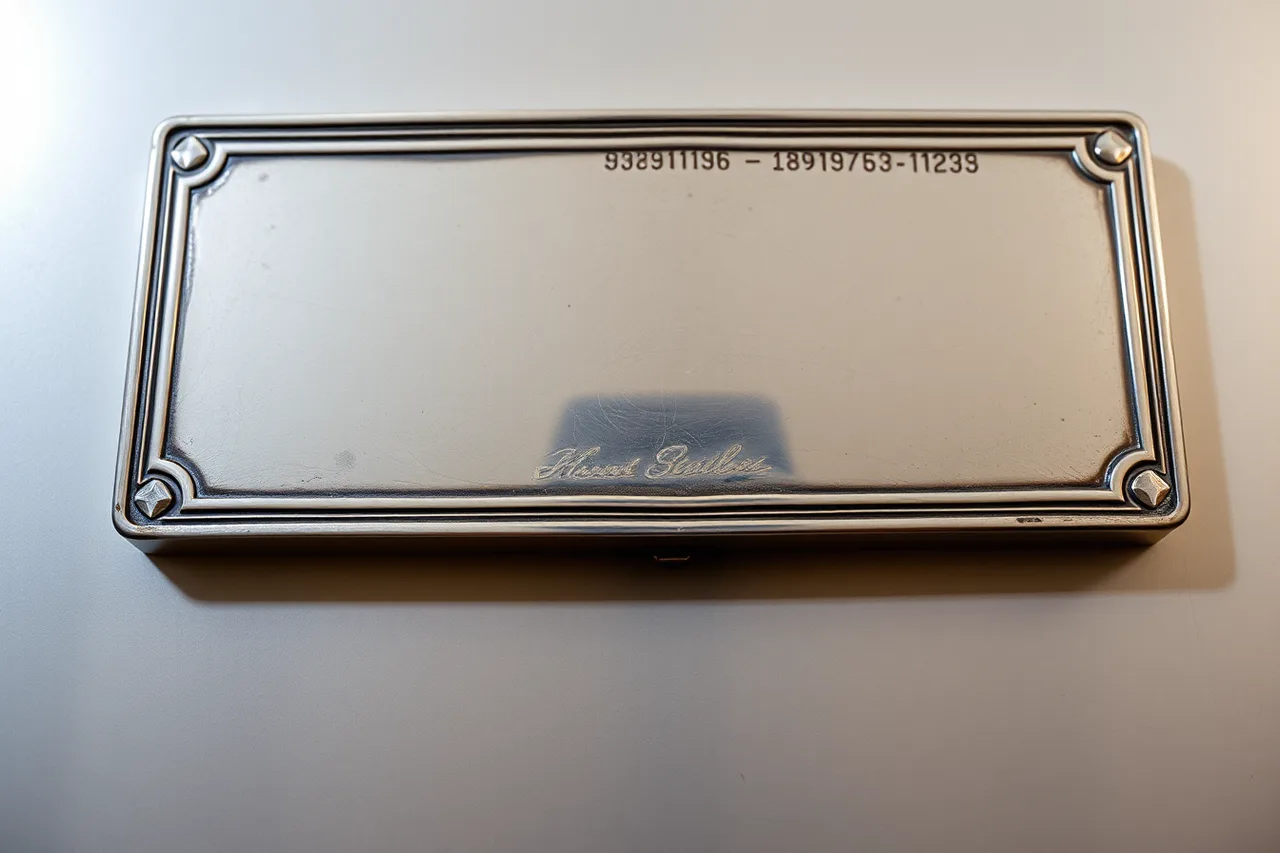
The drawing called for 2 mm leaf stamps centered 2.8 mm from the edge across 11 impressions, with equal corner margins and a 4 mm solder zone clear of the stamp field. The observed row showed a cumulative 0.38 mm outward drift at the final leaf and a slight baseline rotation; spacing between centers held. The full coordinate record follows.
| Feature | Drawing | Observed |
|---|
Drawing vs observed measurements
Drawing
- Border offset at motif 1
- 2.80 mm
- Border offset at motif 6
- 2.80 mm
- Border offset at motif 11
- 2.80 mm
- Maximum center-spacing error
- 0.08 mm
- Released corner lift
- 0.20 mm max
- Reverse witness
- Sample limit
Observed
- Border offset at motif 1
- 2.81 mm
- Border offset at motif 6
- 2.93 mm
- Border offset at motif 11
- 3.19 mm
- Maximum center-spacing error
- 0.06 mm
- Released corner lift
- 0.14 mm
- Reverse witness
- Within limit
The table above preserves the record format; the workshop file retains every numbered impression coordinate.
The spacing was acceptable, but the baseline had rotated. The remaining distance could not return to the original line without an obvious kink.
Why the team preserved the evidence
A Metropolitan Museum study of silver decoration notes examples in which small border ornaments appear to divide space into halves, quarters, and eighths and may have been worked before pictorial decoration. That historical observation did not dictate this repair, but it reinforced a design principle: border rhythm and sequence should be evaluated as a whole before one mark is altered.
The team rejected three immediate responses:
- restriking the drifting leaves, because their centers were already clear;
- filing the outer halves, because the minimum margin was limited;
- bending the panel while supported, because that would hide released distortion and risk the future lid joint.
Root cause
The start and pitch layout were correct. The baseline had been transferred from a temporary edge strip that shifted after the fourth impression. Later centers were still spaced from the previous marks, so spacing held while the row rotated.
How the baseline drifted
- Start and pitch layout correct
- Baseline transferred from temporary edge strip
- Strip shifted after fourth impression
- Later centers spaced from previous marks
- Spacing held while row rotated
The stamp, hammer, and block passed inspection. Matching stock did not reproduce the drift when centers were measured from a fixed panel datum. The cause was classified as reference movement plus progressive registration, not defective silver or an unstable stamp.
Repair alternatives
The team drew three full-size options:
- stop the row and leave an asymmetrical open corner;
- add a corner cartouche that intentionally changed the border direction;
- trim the panel smaller and restart the entire object design.
Option 2 was selected for trials because it could contain the visible turn without touching the existing impressions or entering the 4 mm solder zone. The cartouche was not a mark disguised by random extra texture. It was a new, bounded design element with a stated center, width, depth, and relationship to the next border.
Coupon trials
Three matching coupons reproduced the 0.38 mm outward drift at the final leaf. The proposed cartouche was stamped once at a fixed coordinate, followed by a newly indexed perpendicular row.
The team checked:
- visual transition under four orientations of raking light;
- center and edge coordinates;
- face and reverse depth;
- released flatness;
- remaining solder-zone width;
- minimum measured thickness;
- change after the planned satin finish.
The first coupon failed because the cartouche was too deep. The second failed because the new row began too close to it. The third passed with the original leaf depth and a larger transition gap.
Work and release
The panel was secured on the accepted support and remeasured from its fixed centerlines. The cartouche and first perpendicular anchor were completed, inspected, and approved before the interval was filled. No existing leaf was struck again.
The final job record separated material, dimensions, techniques, and inscriptions rather than treating decoration as identity, consistent with standard museum cataloguing practice for silver objects that lists material and decorative evidence separately.
The panel passed the revised drawing limits—centers at 2.8 mm from the edge, solder zone within 4 mm, drift contained at 0.38 mm—along with the flatness gauge, reverse-witness check, minimum thickness, and satin-finish sample. The deviation report retained the original drawing, measured map, cause, three coupons, revised approval, and final images. The panel carried its "sterling" mark per the FTC Jewelry Guides (16 CFR Part 23), confirming 925/1000 fineness.
What prevented a repeat
- Baselines were transferred directly from permanent panel datums.
- Every fifth center was checked back to the origin.
- Temporary straightedges were banned as production references unless clamped and verified.
- The border traveler gained an early released-shape and baseline hold point.
Common questions
Was the misaligned border erased?
No. The accepted redesign contained the turn without restriking or removing the existing leaves.
Why not simply average the remaining error?
The required correction would have created a visible kink and reduced the corner margin below the drawing.
Does adding a cartouche always fix border drift?
No. It worked only in this fictional geometry after matching trials and a formally revised design.
Why keep failed coupons?
They document rejected depth and spacing choices and help prevent those conditions from being repeated.