Guides
How to Read a US Silver Maker's Mark When There Is No Assay Office
How to read a US silver maker's mark with no assay office: use state historical societies, trade catalogs and maker registers, plus what federal law allows.
The question of how to read a US silver maker's mark is a records problem, not a laboratory one. With no assay office and no national registry, identification runs through state historical societies, trade catalogs and published maker registers such as Ensko, Belden and Kovels.
What to take away
- The United States has no assay office and no central mark registry. Marks are private stamps, so identification runs through directories, catalogs and historical societies rather than a government database.
- Federal law regulates the word "sterling" and its abbreviations, not who may strike a mark. That gap is why two pieces with the same stamp can come from different decades.
- Work the mark in layersquality stamp, maker name or initials, then style and construction. Any one layer alone is weak evidence.
- Maker registers and trade catalogs are the closest thing to a lookup table. Expect to search several before a name matches.
- Photograph the mark, the object and any paperwork before you handle the piece further.
Why the American system has no assay office
In Britain a piece goes to an assay office, gets tested and receives a date letter. The United States never built that apparatus. Congress chose disclosure over inspection, so a maker stamps a quality claim and stands behind it.
US vs British Silver Marking
Britain
- Testing
- Assay office tests
- Date letter
- Issued
- Register
- Official index
- Legal basis
- Assay system
- Maker's role
- Submits to office
United States
- Testing
- No inspection
- Date letter
- None
- Register
- Scattered records
- Legal basis
- 15 U.S.C. § 294
- Maker's role
- Stamps quality claim
The relevant statute is 15 U.S.C. § 294, part of the National Gold and Silver Stamping Act of 1906, which fixes what the word "sterling" and the abbreviation "ster." may mean when applied to silver. It sets a definition. It does not appoint an inspector, issue a date letter or keep a register. The Federal Trade Commission's Guides for the Jewelry, Precious Metals, and Pewter Industries (16 CFR Part 23) govern how those terms may be used in advertising, but they create no registry either.
That single fact shapes every search you will run. There is no office to write to and no index of marks by year. What exists instead is a scattered record kept by museums, libraries and collectors.
What a mark can and cannot tell you
A quality stamp answers one question. It says the metal meets a stated fineness, and nothing more. It does not name the maker, the city or the year, and no office stands behind it to confirm the claim.
What Each Mark Tells You
Quality stamp
- Answers
- Metal fineness
- Example
- Sterling, ster.
- Gives a date
- No
- Reliability
- A claim
Maker's mark
- Answers
- Who struck it
- Example
- Shop or person
- Gives a date
- No
- Reliability
- A claim
A maker's mark answers a second question. It names the shop or the person who struck the stamp — think Gorham, Reed & Barton, Samuel Kirk & Son, or a pair of initials. Punches of this kind were reused across trades and across decades, a habit shared with the maker's mark traditions of other crafts, which is why a name alone rarely settles a date.
Neither mark carries a date. American pieces are dated by style, by construction method and by the firm's known operating years. A piece can be genuine sterling and still be impossible to date to a single year.
A mark is a claim, not a certificate. Treat every stamp as something to corroborate rather than something to trust on sight.
Questions to ask before you buy or value a marked piece
Sourcing a marked object is a research purchase. Ask these five questions before money changes hands:
- What exactly does the stamp saya quality word, a maker's name, a set of initials, or all three?
- Can the seller name the maker and the city or state where the piece was made?
- Which reference backs that identificationa published maker register, a trade catalog, a city directory or a historical society's records?
- Do the style, the construction and any surviving paperwork point to the same period as the mark?
- Has the metal itself been tested, and if so, how and by whom?
Pre-Purchase Mark Checklist
- In-focus photo of the mark, angled to show depth
- Seller names the reference used to attribute it
- Solid or plated, with supporting evidence
- Return window if a register contradicts it
- Repairs and any stamps they carry
A seller who cannot name a reference is guessing. That is not automatically dishonest, but it changes what you should pay.
Where the records actually live
Three source types do most of the work, and all three can be searched by name.
- State and regional historical societies hold business records, city directories and sometimes the surviving dies of a local shop. The Historical Society of Pennsylvania, the New-York Historical Society and the Massachusetts Historical Society are the deepest for Philadelphia, New York and Boston silver; start with the society for the city where the piece was likely made.
- Trade catalogs and period advertisements show what a firm sold and when. The Smithsonian Libraries' trade literature collection and the Hagley Museum and Library in Wilmington, Delaware, hold large runs, and reprint collections of catalog pages are common in research libraries.
- Maker registers compiled by collectors and curators cover the major firms and many small ones. Robert Ensko's American Silversmiths and Their Marks, Louise Conway Belden's Marks of American Silversmiths, Ernest Currier's Marks of Early American Silversmiths and Ralph and Terry Kovel's Kovels' American Silver Marks are the standard starting set. They disagree with each other, so check two.
A city directory entry gives you a working address and a span of years. That span is often the only date range you will get, and it is usually enough to place a piece within a generation.
For quick comparisons, the online mark references at 925-1000.com and kovels.com show photographed stamps, and the open-access collections of the Metropolitan Museum of Art, the Smithsonian's National Museum of American History and the Winterthur Museum let you check a mark against a documented piece.
If the metal itself is uncertain, the guide to identify and document an unknown silver-colored metal sets out how to record weight, color and test results so a later researcher can use your notes.
Reading a mark, step by step
- Read the quality word first. "Sterling," "ster." and "925" all claim 925 parts silver per thousand. If the piece is plated, the words will say so rather than claim a fineness.
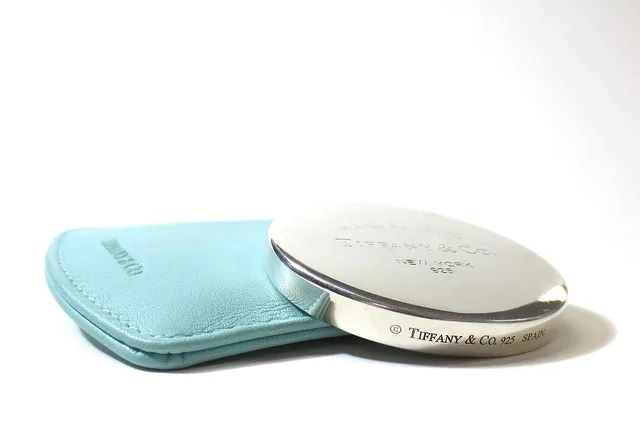
- Read the name or initials next. A full name points to a firmGorham of Providence, Reed & Barton of Taunton, Massachusetts, Tiffany & Co. of New York, Samuel Kirk & Son of Baltimore, Paul Revere of Boston. A pair or trio of initials points to an individual silversmith, and initials are the hardest thing to place.
- Look for a city stamp. Some shops struck the city of manufacture or of retail beside the name, and that city tells you which historical society and which city directories to search.
- Match the name in a register, then pin the working years with a city directory entry or a trade catalog page.
- Date the piece by style and construction rather than by the stamp. A punch could stay in use for decades under the same name.
- Treat British-looking symbols with suspicion on American silver. A lion, a crown, an anchor or a shield struck on a US piece is a decorative pseudo-hallmark, not an assay mark, because no US assay office ever struck one.
A plain example: a spoon stamped "STERLING" above "GORHAM." The top line is a fineness claim, the bottom line is a firm, and neither carries a date — dating has to come from the firm's recorded operating years, the object's style and how it was made.
Condition is a further check. A crisp, deep stamp on a piece whose surfaces are worn thin deserves a second look, because a mark can be re-struck years after the object was finished.
What labels do and do not tell you
The label term that matters most is "sterling." Under the federal definition it means the article is at least 925 parts silver per thousand. "Coin" and "coin silver" are trade terms with no fixed federal meaning, and they commonly describe an alloy near 900 parts per thousand.
"Silver plate" means a base metal with a silver layer. Plated ware usually says so, with "EPNS" for electro-plated nickel silver or "quadruple plate" for heavy plating, and the plated ware entry covers how it differs from solid, which matters because plated marks often imitate solid ones.
A label does not tell you the maker, the year or the country of origin. It tells you what the metal claims to be. For the full set of fineness figures and the tests that confirm them, see the silver alloys guide.
Storing what you buy
Store marked silver dry and away from rubber bands, newspaper and wool. Sulfur compounds in those materials tarnish the surface, and heavy tarnish obscures a stamped mark under a dark film.
Keep each piece in a tarnish-resistant bag or a lined box, and keep the paperwork with the object rather than in a separate file. If a mark is faint, a soft eraser used lightly can lift surface tarnish without cutting metal. Abrasive polishing removes the very detail you are trying to read.