Guides
Cast, Fabricated or Die-Struck: Reading Silver Method and Marks
Cast, fabricated and die-struck silver is judged by its interior, weight and marks. Sterling stamps, chain repair and plated pieces, explained for US buyers.
What to take away
- Cast, fabricated and die-struck are three ways to make one silver shape, and each leaves a different interior finish and repair story.
- A sterling mark states the alloy is 92.5 percent silver. It says nothing about method or maker.
- Cable and curb silver chains can be fixed at any bench. Snake and herringbone usually cannot.
- Ask the seller for the fineness mark, the method and the chain type in writing before you pay.
Two silver pendants can look identical in a photograph and still be made three different ways. Method decides weight, surface and repairability, and an overview of the routes sits in how silver jewelry is made, which also covers solid against plated stock.
Three ways a silver piece is formed
Almost all silver sold in the United States takes one of three production routes.
Casting pours molten silver into a mold taken from a model, usually through lost-wax casting, which is the method behind most commercial silver.
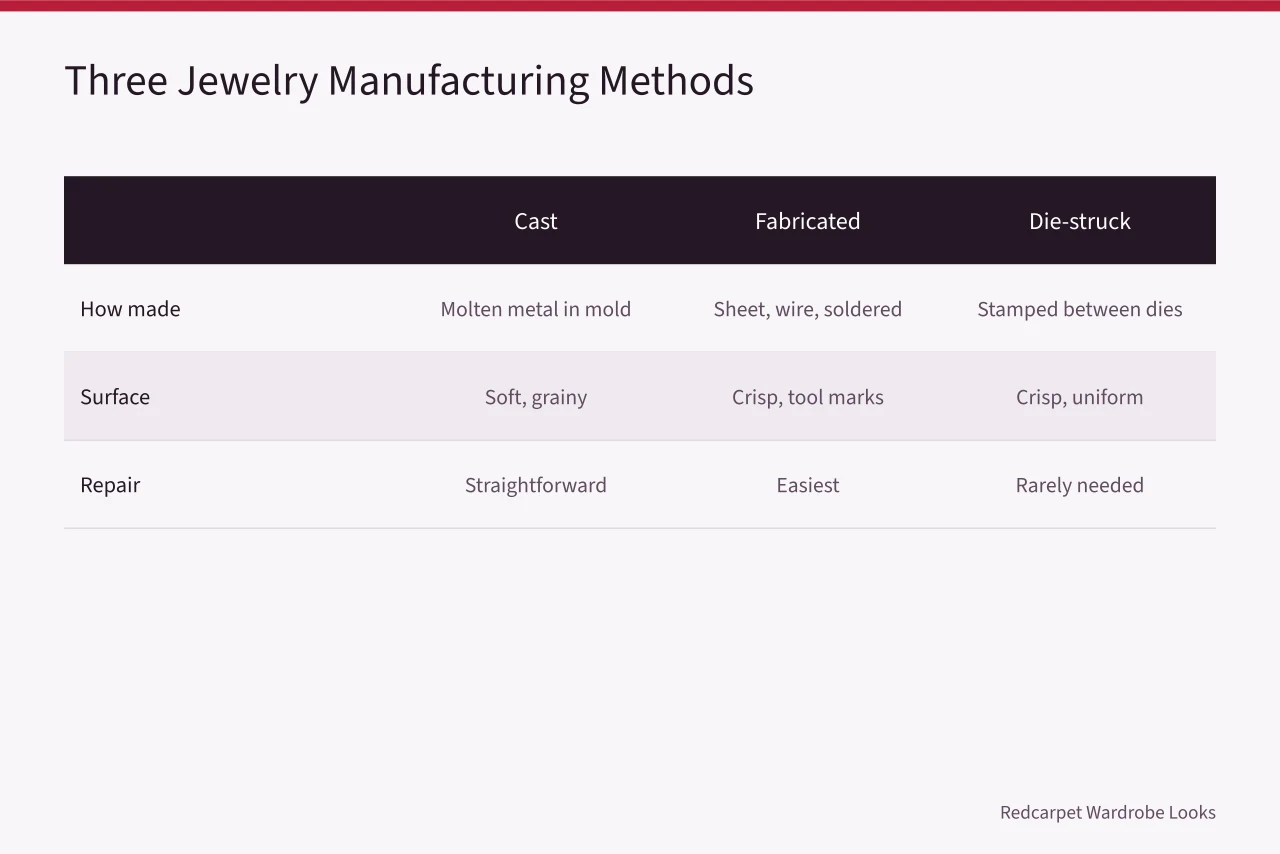
| Method | How it is made | What it leaves | Repair |
|---|---|---|---|
| Cast | Molten silver poured into a mold | Soft detail, occasional porosity | Workable, but porosity complicates soldering |
| Fabricated | Sheet and wire, cut and soldered by hand | Crisp edges, visible seams, denser metal | Easiest, since it was assembled from parts |
| Die-struck | Stamped between hardened dies | Dense, hard, sharp detail, heavier for its size | Rarely needed on a sound piece |
Weight is the fastest clue. Die-struck silver is the densest of the three.
A fabricated piece gives itself away under a loupe: seams, solder lines and slightly irregular edges that no mold produces.
Casting softens detail, so lettering and pattern read as rounded rather than cut. A workshop choosing between the routes compares them in lost wax versus sand casting before buying molds.
Reading a silver piece at the bench
Four checks settle most questions about how a silver piece was made, and none takes more than a minute at the counter by eye and by hand.
- Loupe the inside of a shank, or the back of a pendant. A grainy, matte interior points to casting, while tool marks point to fabrication.
- Compare surface detail. Very crisp, uniform work points to die-striking, while vague or rounded edges point to a mold that has lost its shape.
- Weigh it against a similar piece of the same size. Die-struck silver is heavier for its volume, and cast silver is often lighter than it looks.
- Look for a seam or a solder line. Either one means the piece was assembled from parts rather than cast whole, and the joint is usually visible at an angle.
Casting faults sit on the surface rather than inside it. The cracks, wrinkles and springback described under silver forming problems separate a sound casting from a rushed one, and most bench jewelers spot them in seconds.
Silver chains and clasps that can be repaired
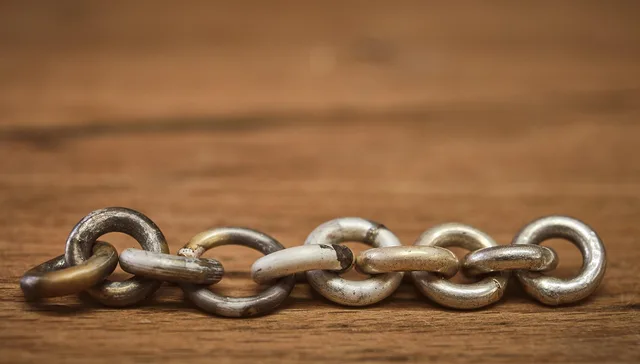
Silver chains are hardware, so a broken link is a repair question.
- Cable. Round or oval links, strong, easy to repair, the default for a pendant.
- Curb. Flattened twisted links that lie flat, durable and heavy for their length.
- Box. Square links forming a smooth section; strong, and it kinks permanently if bent.
- Snake. Closely fitted plates forming a tube; elegant, and unrepairable once creased.
- Herringbone. Flat angled links forming a ribbon; the most fragile common family.
A lobster clasp with soldered links is the safe choice for daily wear, and any bench can replace it.
A seller who will not name the metal or the method in writing is the same problem as a chain no bench can repair. The checks to run before paying are set out in buying real sterling silver online.
What a sterling mark says and what it does not
A sterling mark means 92.5 percent silver by weight, and nothing about how the piece was formed. In the United States, 15 U.S.C. § 294 sets the legal definition of the word.
Fineness marks state the alloy. Sterling silver is 925 parts in 1,000, fine silver is 999, and 800 marks a lower grade seen in European work. Plating carries no such figure, because the metal underneath is not silver.
A precious metal stamp is a legal claim rather than decoration, and American labeling rules treat a false stamp as a violation of the guides for the jewelry trade.
Most countries run an assay office that tests and stamps silver before it is sold. The United States has no such office, so a maker's stamp is often the only evidence on the piece. What those letters and symbols can prove is explained in reading a US maker's mark, written for pieces with no assay record.
Common questions
Is a cast silver ring worse than a die-struck one?
No, softer. Die-struck silver is denser and holds up better on a shank worn daily.
Which silver chain should I buy for a pendant I wear daily?
A cable or curb chain with soldered links and a lobster clasp. Any bench can repair both.
Does a sterling stamp prove a piece is not plated?
It is evidence, not proof. Plated silver is often stamped 925 on the plating itself.