Rules
Part of Silver soldering guide: fit, heat, and inspection
Silver soldering problems: diagnose failed joints
Silver soldering problems can involve poor fit, flux, filler, heat, or contamination. Learn how to inspect failed joints and assess rework risks.
What to take away
- Silver soldering problems should be diagnosed after a safe shutdown; do not answer resistance with more flame.
- Separate fit, cleanliness, flux, filler identity, heat distribution, and contamination as possible causes.
- Excess solder can hide a poor seam and make finishing remove too much parent metal.
- Firestain, pitting, melted edges, and shifted joints require measured limits before rework.
- Unknown or overheated material stays segregated from clean scrap.
Keep the work, solder remnants, flux label, stock record, setup photograph, and heat notes. Clean only as needed for inspection. Aggressive filing can erase the evidence and create a second defect.
Solder will not flow
Check in this order:
- Stop heating and let the work cool; do not add solder or respond with more flame.
- Inspect the seam for a gap, poor fit, surface dirt, oxide, old solder, or flux residue.
- Confirm the flux is intended for silver soldering. Borax-based flux and jewelry-grade paste flux are common options; follow the product directions.
- Identify the filler grade—hard, medium, or easy—and check the manufacturer’s stated flow range. These grades generally flow from higher to lower temperatures in that order; exact ranges vary by product.
- Heat the assembly evenly so the work brings the filler to flow, rather than concentrating the flame on the solder alone.
- After cooling, use a jewelry pickle such as sodium bisulfate according to its label, then inspect the seam and test any proposed rework on a same-batch coupon.
Solder Flow Check Order
- Filler identified and oriented
- Joint fit across full length
- Both faces clean after fitting
- Flux correct, active, covering joint
- Assembly heated, not just chip
- Large support pulling heat away
- Plating, oxide, old solder, contamination
Do not keep adding solder. A GIA fine-chain repair lesson identifies incomplete flow, excess solder, and fused neighboring links as distinct risks in a delicate repair. The method is specific to fine chain and should not be transferred wholesale to a box or heavy seam.
Flooded joint
A solder pool may result from excessive filler, a misplaced chip, a gap, overheating, or heat that pulls the filler away from the seam. Photograph the pool before cleanup and locate the original joint boundary.
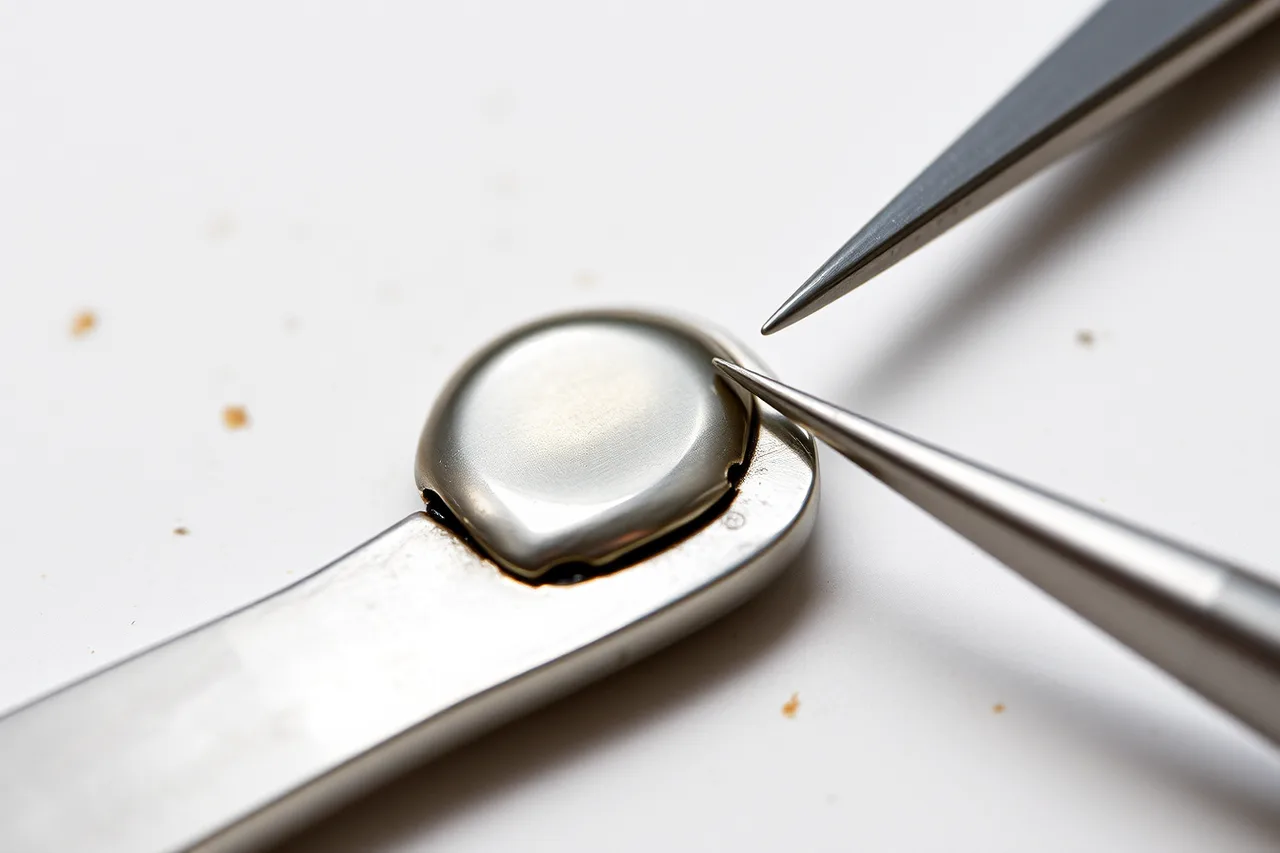
Do not file the surface flat until remaining wall thickness and detail are measured. Excess solder can sit over an unfilled gap. If removal would damage the base metal, reject, redesign, or refer the work.
Firestain and surface damage
Distinguish loose flux residue, surface oxide, subsurface copper-rich firestain, melted texture, and abrasive damage. In sterling silver, heating can form copper oxide below the surface; a sodium bisulfate pickle can remove some surface oxides but will not remove deeper firestain. A boric-acid/alcohol firecoat applied before heating can help limit oxidation; follow its safety directions and keep flammable materials away from ignition sources. Existing firestain may require depletion silvering or controlled abrasive removal, subject to the material-removal allowance.
Before sanding, locate and protect any maker’s mark and fineness mark, and record their positions. Set a maximum material-removal allowance before sanding. Protect hallmarks, edges, engraving, and mating dimensions. A surface that looks uniform after heavy polishing may be dimensionally unacceptable.
Pits and collapse
Pits can appear when filler is overheated, gases or contamination disrupt flow, or finishing opens an existing void. Thin edges and unsupported walls can slump when the base metal approaches an unsafe temperature.
Map the damage by location and depth. Do not refill pits blindly. If the parent metal has eroded, become porous, or lost section, the joint may need reconstruction rather than another heat cycle.
Shifted earlier seams
A later operation can remelt an earlier filler or soften the assembly enough for gravity, binding, or thermal expansion to move it. Compare current dimensions with the preheat record.
Review the exact working ranges, support, flame path, heating time, and mass distribution. Hard, medium, and easy silver solders have progressively lower flow-temperature ranges, but a lower-temperature grade alone does not guarantee protection of previous joints. Use the specific manufacturer’s flow range and test the sequence on a coupon.
Contamination and exposure
Possible contaminants include mixed solder chips, iron particles, polishing compound, dirty blocks, plating, old lead or cadmium solder, zinc-rich parts, adhesive, and unknown repairs. Stop heating unknown material.
The University of Illinois soldering safety guidance calls for ventilation, safety-data review, clean work areas, and procedures covering hazards, setup, protective equipment, cleanup, waste, and emergencies. Its examples include electronic soldering, so a jewelry torch assessment must also address flame, fuel, higher temperatures, and jewelry-specific products.
Corrective trial
Use labeled coupons from the same batch. Change one factor at a time: fit, cleaning, flux, solder amount, support, or heat path. Record the result. A successful coupon does not automatically approve rework on a stone-set, customer-owned, hollow, or historic object.
Common questions
Why does solder form a ball?
Check surface cleanliness, flux condition, filler identity, joint temperature, contamination, and heat direction.
Can excess solder be polished away?
Only within measured base-metal and design limits, after confirming the seam underneath is sound.
Does firestain mean the piece is ruined?
Not automatically. Diagnose its depth and set limits for treatment, dimensions, and finish.
How many reheats are acceptable?
There is no universal count. Each cycle needs a reason, heat-risk review, and inspection.